
College Degree ROI Calculator: Are the Student Loans Worth It?
College can be one of the best financial decisions you ever make — or one of the most expensive mistakes. The difference often comes down to a single question most students never formally answer: what return will this degree actually produce?
The Student Loan ROI Calculator helps you answer that question before you commit. Compare the real earnings potential of a degree path — after accounting for your student loan costs — against a no-degree career path. See the break-even point, the lifetime income difference, and whether the debt is actually worth it for your specific situation.
Most people evaluate the cost of college emotionally, not financially. They think about campus culture, career prestige, and family expectations — not about what the debt will actually cost them over a 20 or 30-year repayment window.
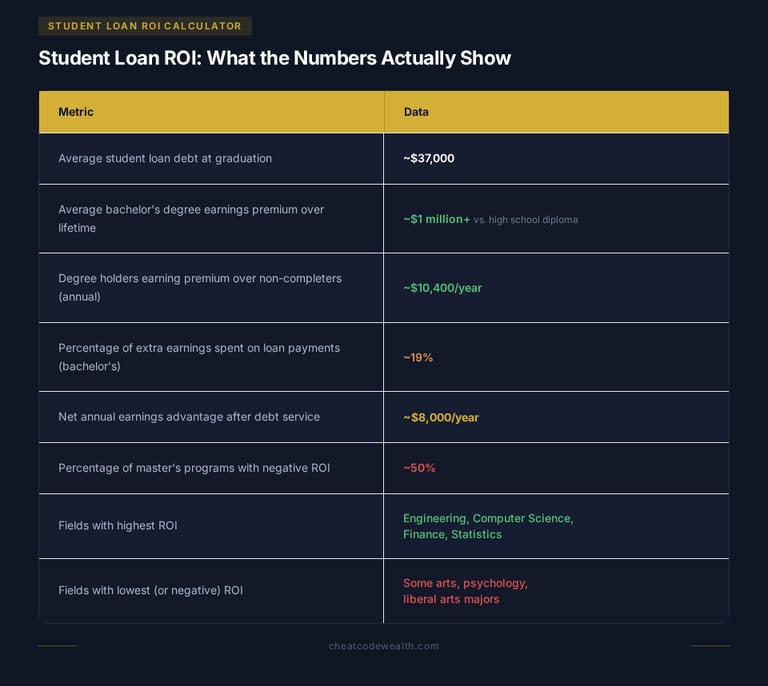
Here's what the numbers actually look like at the national level:
Why Student Loan ROI Matters More Than Most People Realize
The key insight: Whether a degree is worth it depends almost entirely on what you study, where you study, and how much you borrow — not on whether college is "good" or "bad" as a concept.
This is exactly what the Student Loan ROI Calculator is designed to help you figure out for your specific situation.
The Student Loan ROI Calculator works by modeling two paths side by side:
Path A — The Degree Path:
You borrow money to pursue a college degree. After graduation, you earn a higher salary than you would have without it. But your loan payments reduce your actual take-home advantage — sometimes significantly.
Path B — The No-Degree Path:
You enter the workforce immediately, skip the tuition debt, and begin earning and investing sooner. Skilled trades, apprenticeships, certifications, and entrepreneurial paths can generate strong income without a four-year degree.
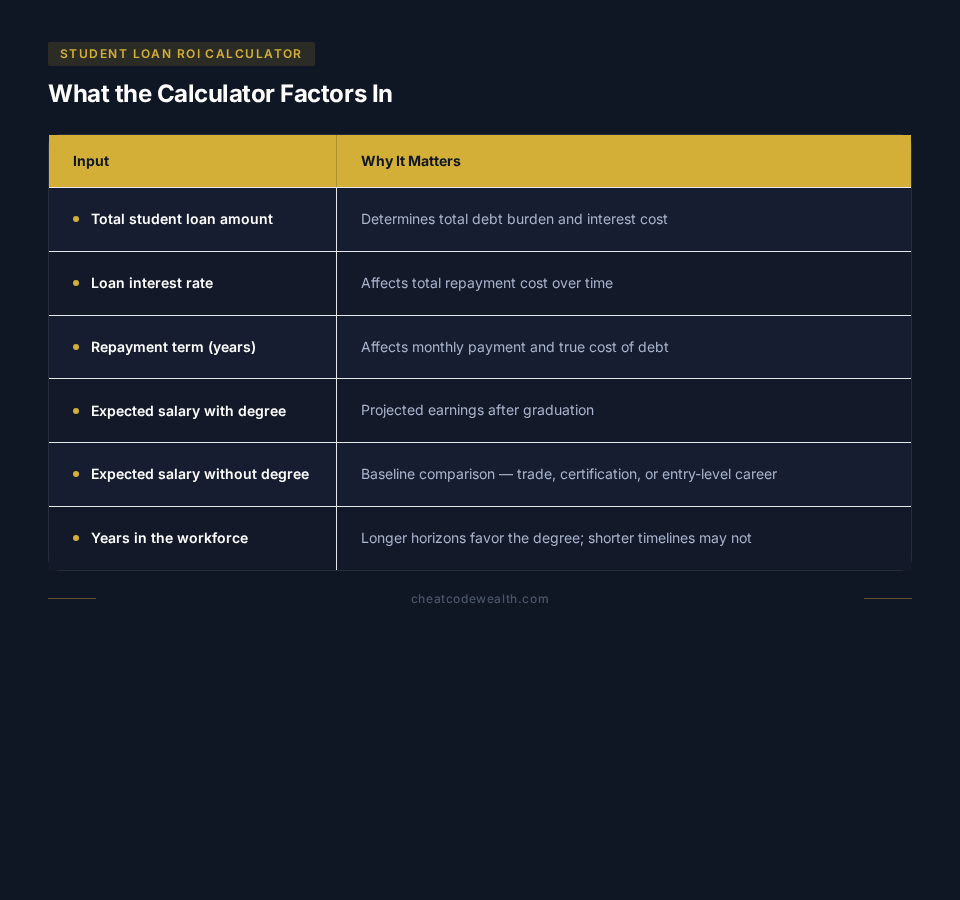
The calculator factors in:
What the Calculator Compares
What the results show you:
Total loan repayment cost (principal + interest)
Net income advantage of the degree path after debt payments
Break-even point — the year your degree starts paying you back more than it cost
Lifetime income comparison across both paths
The student loan ROI equation isn't the same for everyone. Here are the key variables that shift the outcome:
Degree ROI tends to be HIGH when:
The salary premium between degree and no-degree paths is large (engineering, nursing, accounting, CS)
Total debt is kept low relative to expected starting salary (a common rule: borrow no more than your expected first-year salary)
The degree is from an institution with high graduation rates and strong job placement
The student graduates on time and enters a growing field
Degree ROI tends to be LOW (or negative) when:
The degree field has a low earnings premium over non-degree alternatives
Debt significantly exceeds expected starting salary
The student does not graduate (debt with no earnings boost is the worst outcome)
A skilled trade, certification, or apprenticeship in the same field pays comparably without the debt
The no-degree path wins more often than people think:
Skilled trades — electricians, plumbers, HVAC technicians, welders — regularly earn $60,000–$90,000+ annually, with far lower training costs and zero student loan debt. In many ROI calculations, a plumber who invests the equivalent of a four-year tuition into income-producing assets will outperform a psychology or liberal arts graduate over a 30-year career.
This isn't a knock on education. It's a case for running the numbers.
When a Degree Is — and Isn't — Worth the Debt
Step 1 — Enter your total expected student loan amount.
Include all loans — federal, private, and any you anticipate adding over the full degree program.
Step 2 — Enter your loan interest rate and repayment term.
Use your actual rate if you have one. Federal student loan rates and typical private loan ranges are a good benchmark if you're estimating.
Step 3 — Enter your expected salary with your degree.
Research median starting salaries for your specific field and degree level — not the highest possible salary, but the realistic middle. Use resources like the Bureau of Labor Statistics Occupational Outlook Handbook for accurate data.
Step 4 — Enter your expected salary without the degree.
Be honest here. Research what you'd realistically earn through a trade certification, apprenticeship, direct entry-level role, or alternative path. This comparison only works if both sides are realistic.
Step 5 — Review your ROI results.
The calculator shows you total loan cost, net income advantage, and your break-even year. Use this to make a decision grounded in numbers — not assumptions.
Pro tip: Run the calculator with your realistic salary estimate, not your best-case scenario. Student loan ROI looks very different at $45,000/year vs. $70,000/year starting salary for the same $50,000 in debt.
How to Use the Student Loan ROI Calculator
Here's something most college guidance counselors won't tell you: student loan payments are a direct drag on your ability to build passive income and financial freedom.
Every dollar going toward student loan payments is a dollar not going into income-producing assets. And unlike mortgage debt (which builds equity) or business debt (which generates cash flow), student loan debt is a pure cost — it only pays off if the salary premium exceeds what you paid to borrow it.
Consider the compound cost:
$37,000 in student loans at 6.5% over 10 years = approximately $50,000 in total repayments
That same $50,000 invested at 7% annual return over 30 years = approximately $380,000
The true cost of student loan debt isn't just the interest you pay — it's the opportunity cost of not investing that capital during your peak compounding years. The Student Loan ROI Calculator helps you see whether the earnings premium of your degree outweighs that cost over your working lifetime.
This is the framing the Paycheck-to-Passive™ method is built on: every financial decision should be evaluated in terms of what it does to your passive income timeline and your Freedom Number — not just its face value.
Student Loan Debt and Your Wealth-Building Timeline
What is the Student Loan ROI Calculator?
The Student Loan ROI Calculator is a free tool from CheatCode Wealth that compares the real financial return of pursuing a college degree — after accounting for student loan costs — against a no-degree career path. It shows you your break-even point and lifetime income difference between both paths.
Is this calculator free?
Yes. The Student Loan ROI Calculator is completely free to use with no sign-up or account required.
What does "student loan ROI" mean?
Student loan ROI (return on investment) measures how much you gain financially from a degree relative to what you spent to earn it — including tuition costs, loan interest, and opportunity costs like delayed entry into the workforce or investing.
How is the break-even point calculated?
The break-even point is the year at which your cumulative earnings advantage from having a degree exceeds your total loan repayment cost (principal + interest). Before this point, the no-degree path has put more money in your pocket. After it, the degree path comes out ahead.
Is college worth the debt?
It depends. Degree holders earn an average of $10,400 more per year than non-completers — but after loan payments, the net advantage drops to around $8,000 annually for bachelor's degree holders. Whether that's worth it depends on your specific field, total debt, and what the alternative path looks like. The calculator helps you run the math for your own situation.
What careers don't require a degree but still pay well?
Skilled trades such as electricians, plumbers, HVAC technicians, and welders regularly earn $60,000–$90,000+ annually without a four-year degree. Cybersecurity, real estate, and many sales roles are also accessible without a bachelor's degree and offer strong earning potential.
Does the calculator account for loan interest?
Yes. The total loan repayment cost — principal plus interest over the full repayment term — is factored into the comparison so you see the true cost of the debt, not just the amount you originally borrowed.
What degree fields have the highest ROI?
Engineering, computer science, finance, statistics, and nursing consistently rank among the highest-ROI degree fields. Management information systems and accounting also perform well. These fields combine a large salary premium over no-degree alternatives with relatively strong job placement rates.
What degree fields have the lowest (or negative) ROI?
Some liberal arts, fine arts, and psychology programs can have low or negative ROI compared to no-degree alternatives, particularly when paired with high debt loads at expensive institutions. This doesn't mean the degree has no value — but the financial return may not justify the cost of borrowing.
How does student loan debt affect wealth building?
Student loan payments reduce the capital available to invest in income-producing assets each month. The opportunity cost is significant: money spent repaying loans during your 20s and 30s misses decades of compounding growth. This is why evaluating student loan ROI is a core part of the wealth-building decisions discussed in the Paycheck-to-Passive™ method at CheatCode Wealth.
Frequently Asked Questions
Related Guides
Explore related guides and tools to go deeper on this topic.

Put your financial plan into action.
Join the Portfolios & Bedtime Stories newsletter for expert insight and community collaboration.
CheatCode Wealth™
Build your wealth. Keep your life.
© 2025. All rights reserved. Cheatcode Wealth LLC. This webpage may contain paid affiliate links.