
3 Companies That Pay for College: Earn Your Degree While Earning A Paycheck
Discover 3 major employers—Starbucks, Walmart, and Target—that will pay 100% of your college tuition while you work. Here's exactly how to qualify.
ACTIVE INCOMEMONEYAPPSTOOLSCAREERS & JOBS
Garrett Duyck
2/27/202611 min read
Quick Navigation: Explore the blog | Active Income | Passive income | Job Shaming | Stairstep retirement


Here's something most people don't realize: you don't have to choose between working and going to college. And you definitely don't have to drown in student loan debt to get a degree.
I know because I did it the hard way.
I was a first-generation college student who bootstrapped my way through by figuring out the application process with a school counselor, earning academic scholarships to cover my first year, and taking on $12,000 in student loans for the rest. After graduation, I paid them off quickly by living frugally—mattress on the floor, computer desk, and not much else.
It worked out. But looking back, I wonder how much easier it would have been if I'd had an employer covering my tuition from day one.
The reality is this: several major employers will now pay for your entire college degree. Not partial reimbursement. Not some complicated loan forgiveness scheme. They'll pay your tuition upfront, sometimes including books and fees, while you work.
But here's the thing—and this is important—going to college just because it's free is still a bad investment. As I always say: college is an investment. Some people make a good investment and some make a bad investment. What determines if it's good or bad is what the student does with the degree.
So before you jump into one of these programs, make sure you have a plan. If your answer to "Why are you going to college?" is just a degree—or worse, "I'll figure it out"—you're not ready. Go work first, gain perspective, then make a plan.
With that said, let's look at three major employers that can help you earn a degree without the debt.
Starbucks College Achievement Plan
Starbucks was one of the first major retailers to offer comprehensive tuition coverage, partnering with Arizona State University in 2014 to create the Starbucks College Achievement Plan (SCAP). Here's exactly how it works.
Program Overview
Starbucks covers 100% of tuition for eligible employees pursuing a first-time bachelor's degree online through Arizona State University. This isn't a reimbursement program—they pay ASU directly, so you never see a bill.
You can choose from 100+ online bachelor's degree programs across business, education, health and wellness, liberal arts, science and technology, and more.
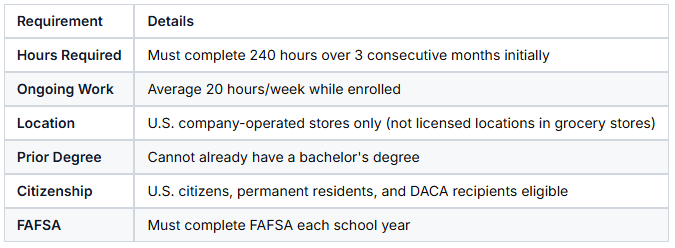
Eligibility Requirements
Coverage Details
Tuition and mandatory fees: 100% covered
Books: Not covered (but financial aid may help)
Student loans/housing/transportation: Not covered
One important note: the Starbucks Tuition Benefit is tax-free up to $5,250 per year under IRS Section 127. Anything above that gets reported as taxable income on your W-2. This shouldn't scare you off—free education that's partially taxed is still much better than paying full price.
How It Works
Log into the Starbucks Partner Hub and activate your education benefits
You'll be directed to Guild Education (their third-party partner)
Apply to ASU's online program
Get matched with an academic success coach
Choose your degree program
Submit transcripts and verify employment
Start classes—tuition is covered upfront
Not academically ready? Starbucks offers a "Pathway to Admission" program. If you don't initially qualify for ASU, you can take up to 10 college-level courses (fully covered by Starbucks) to earn admission. No books or materials costs in this pathway program either.
The Catch
Only ASU: You're limited to Arizona State University's online programs. Great school, but if you have your heart set on a specific university, this won't work.
Company-operated stores only: If you work at a Starbucks inside a Target, grocery store, or airport, you likely work for a licensee—not Starbucks—and won't qualify.
Hours commitment: You need to maintain that 20-hour weekly average while enrolled. Dropping below could affect your eligibility.
Veteran Bonus
If you're a U.S. veteran working at Starbucks, you can extend a "plus-one" benefit to a qualifying family member. They get the same 100% tuition coverage while you also pursue your own degree.
Bottom Line
The Starbucks program is rock solid for the right person. If you can secure 20+ hours per week at a company-operated store and an ASU online degree aligns with your career plan, this is one of the cleanest paths to a debt-free bachelor's degree.
But remember: have a career plan for that degree. Don't just pick business administration because it sounds professional. Know what job you want, research what it pays, and make sure the degree gets you there. That's what makes it a good investment.
Walmart Live Better U
Walmart's Live Better U program is one of the most comprehensive employer education benefits in the country. And with 1.6 million U.S. employees, they've made higher education accessible to a massive workforce.
Program Overview
Walmart covers 100% of tuition AND required books for eligible programs. Unlike many employer programs, this isn't reimbursement—Walmart pays directly to the school, so you never have out-of-pocket costs.
The program spans everything from high school completion to bachelor's degrees, with a focus on credentials that lead to higher-paying roles.
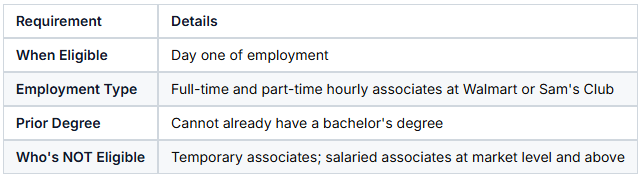
Eligibility Requirements
Day one eligibility is huge. No waiting period. No probationary phase. You can literally get hired and start the enrollment process immediately.
Coverage Details
Tuition: 100% covered
Required books: 100% covered
Program fees: Covered (registration, technology, exam fees, graduation fees)
This is the most comprehensive coverage of the three programs. Books alone can run $500-1,000+ per semester, so having those included makes a real difference.
Programs Offered
Walmart partners with over 25 accredited universities, including:
Southern New Hampshire University (SNHU)
Arizona State University
Purdue University Global
University of Florida
University of Arkansas
Bellevue University
Penn Foster (high school completion)
Program types include:
High school completion and GED prep
English language learning
Professional certificates (Google Project Management, Pharmacy Tech, etc.)
Skilled trades (electrician, plumbing, HVAC, industrial maintenance)
Bachelor's degrees in Business, Computer Science, Supply Chain, Management, and more
The skilled trades options are worth highlighting. You can earn a credential as a residential electrician or plumber while working at Walmart—trades that can lead to six-figure income with business ownership potential.
How It Works
Create an account on the Live Better U portal
Explore available programs (browse by interest or career path)
Connect with a personal education coach through Guild Education
Complete the Guild Education application
Submit a university-specific application to your chosen school
Enroll and start classes, Walmart covers everything
The education coach is a valuable resource. They help you choose programs, navigate enrollment, and balance work with school.
The Catch
Approved schools only: You can't use this at any university you want, only Walmart's partner schools.
No master's degrees: The program focuses on undergraduate education. Some partners offer discounted graduate programs, but they're not covered by Live Better U.
Program alignment: The programs are curated to develop skills relevant to Walmart and general career advancement, which is a good thing because it means the degrees are practical.
Program Impact
The numbers speak for themselves:
Nearly 120,000 associates have participated
Over 19,000 have graduated
Associates have saved nearly $500 million in tuition costs
LBU participants are 2x more likely to be promoted
Turnover is 4x lower among participants
That last stat matters for you: Walmart sees real value in this program, which means it's not going anywhere. This isn't some experimental benefit that might disappear next year.
Bottom Line
Walmart's Live Better U is the most comprehensive of the three programs. Day-one eligibility, tuition plus books covered, and a wide range of partner schools and program types make this accessible to almost anyone.
If you're working retail and wondering whether there's a path forward, this is it. Use the job as a tool to build something bigger. That's exactly what these programs are designed for.
Target Dream to Be
Target launched Dream to Be in September 2021, and it's quickly become one of the most generous education benefits in retail. With a $300 million investment and over 40,000 enrollments, Target is betting big on employee education.
Program Overview
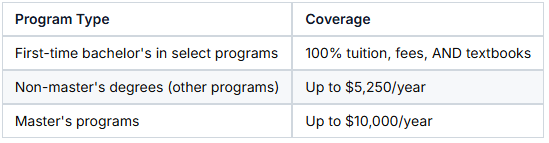
Target offers 100% tuition coverage for first-time degree seekers in select programs, including textbooks and course fees. For programs outside the fully-covered list, they offer substantial annual funding.
The program includes approximately 500 programs across 40+ schools and universities—the broadest selection of the three employers.
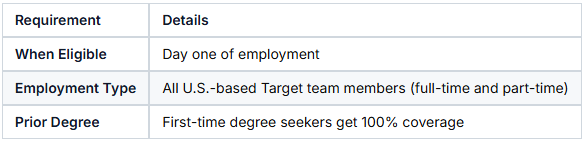
Eligibility Requirements
Like Walmart, Target offers day-one eligibility with no waiting period.
Coverage Details
The tiered structure is worth understanding: if you're a first-time degree seeker and choose from their fully-covered programs, you pay nothing. If you want a program outside that list, you still get substantial support, just not 100%.
Programs Offered
Target partners with Guild Education and offers programs through:
University of Arizona
Oregon State University
eCornell (Cornell University's online platform)
Morehouse College
Paul Quinn College
Plus 35+ other institutions
Program types include:
High school completion and college prep
Language learning (English, Spanish, French, German)
Professional certificates
Bachelor's degrees in Business, Computer Science, Data Analytics, Marketing, Operations, and more
Master's degrees (partially funded)
Bootcamps in AI, analytics, coding, and web development
The inclusion of Historically Black Colleges and Universities (HBCUs) like Morehouse College is notable. If attending an HBCU matters to you, Target is currently the only major retailer offering this through its program.
Bootcamps are another unique offering. If you want to pivot into tech without committing to a four-year degree, Target covers bootcamps in AI, analytics, and web development.
How It Works
Access Dream to Be through Target's employee portal
Create an account with Guild Education
Browse programs and connect with an Education Coach
Apply to your chosen program
Enroll and start classes
Target also offers college credit for select Target training programs, which can accelerate your degree timeline.
The Catch
"Select programs" language: Full 100% coverage is for first-time degree seekers in specific, approved programs. Make sure your desired program is on the list before counting on full coverage.
Business-aligned degrees: Programs must be business-aligned, though there are 250+ fields to choose from—so this isn't overly restrictive.
$5,250 cap for non-select programs: If you want a program outside the fully-covered list, you're limited to $5,250 annually for undergraduate and $10,000 for graduate programs.
Program Impact
Target's internal data shows strong results:
Over 40,000 enrollments since launch
More than 10,000 graduates
Enrolled hourly team members have 76% lower turnover
Participants are 3.5x more likely to be promoted
The promotion stat is what jumps out to me. Earning a degree while working shows initiative, discipline, and commitment. Employers notice that—and promote accordingly.
Bottom Line
Target's Dream to Be offers the widest program selection and unique options like HBCUs and tech bootcamps. If you want flexibility in choosing your school or degree path, Target gives you the most options.
The tiered coverage structure means you need to check whether your specific program is fully covered or capped. Do your homework before enrolling.
How to Make the Most of These Programs
These programs can be genuine game-changers, but only if you approach them strategically. Here's how to maximize the opportunity.
Have a Career Plan First
I can't stress this enough: going to college just because it's free is still a bad investment.
Before you enroll, answer these questions:
What job do I want after graduation?
Does this degree lead to that job?
What does that job pay, and is it worth 2-4 years of my time?
What's my backup plan if the first path doesn't work out?
If you can't answer these questions, you're not ready. Work for a while, gain perspective, and figure out what you actually want. These programs will still be there when you have a plan.
Choose a Degree That Leads Somewhere
Some degrees have clear career paths. Nursing, accounting, computer science, and supply chain management lead directly to specific, in-demand jobs.
Other degrees require you to create your own path. That's fine, but you need to know that going in and have a strategy.
Don't pick a major because it sounds interesting. Pick one because it gets you where you want to go.
Use the Support Systems
All three programs offer education coaches, tutoring, and career advisors. Use them. These resources exist because completing a degree while working is hard. People who use support systems graduate at higher rates than those who don't.
Schedule regular check-ins with your coach. Ask questions. Get help when you're struggling. That's what they're there for.
Don't Sacrifice Everything
Here's where my philosophy differs from much career advice: your job is a tool, not your identity.
These programs let you earn a degree without drowning in debt. That's valuable. But don't grind yourself into the ground trying to work full-time, go to school full-time, and maintain any semblance of a life.
If you need to reduce hours during finals, do it. If you need an extra semester to finish, take it. The goal is to graduate with your degree, your health, and your relationships intact, not to prove how much you can suffer.
Think Beyond the Degree
A degree opens doors, but it doesn't guarantee anything. While you're in school:
Build relationships with professors and classmates (your future network)
Look for internship or project opportunities through your employer
Develop skills that complement your degree
Keep an eye on internal job postings—you may qualify for promotions before you even graduate
The degree is the foundation. What you build on top of it determines your outcome.
The Real Opportunity Here
Here's what most people miss about these programs: they let you stack the deck in your favor.
Think about it. You're earning income. You're avoiding debt. You're building work experience. And you're earning a degree—all at the same time. When you graduate, you'll have zero student loans, years of employment history, and a credential that opens new doors.
Compare that to the traditional path: four years of school, $30,000-100,000+ in debt, and entry-level job hunting with no real work experience.
These programs flip the script. They let you use employment as a wealth-building tool while simultaneously investing in your future earning potential.
That's the cheat code.
You don't have to quit your job to get educated. You don't have to mortgage your future with student loans. You just have to be strategic about how you use the tools available to you.
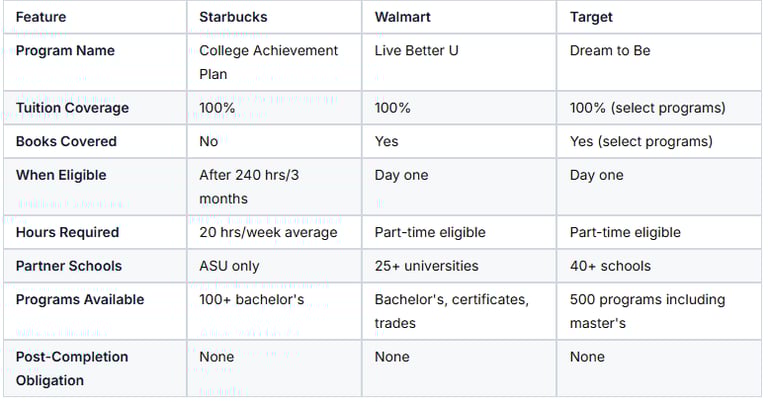
Quick Comparison: All Three Programs
Final Thoughts
Getting a college degree without student debt isn't a fantasy. These three employers, Starbucks, Walmart, and Target, make it possible for millions of workers to earn credentials while getting paid.
But remember: a free degree isn't automatically a good investment. What makes it good or bad is what you do with it.
Have a plan. Choose a degree that leads somewhere. Use the support systems. And treat your job as a tool that's working for you, not just something you're working for.
If you found this helpful and want more strategies for building wealth while keeping your life, I'd love to stay connected. I write about practical ways to grow your income, invest smarter, and design a life that doesn't require sacrificing everything for money.
Your job can be the foundation for something bigger. These programs prove it.
Garrett Duyck is the founder of CheatCode Wealth and the writer behind the Portfolios & Bedtime Stories newsletter. He writes for employed people who want to build wealth without quitting their job, burning out, or missing out on life. Garrett is a former contributor to Seeking Alpha, where he built an audience of more than 4,000 readers, and he has published more than 140 articles about investing, passive income, and personal finance. He was among the top 20% of analysts according to TipRanks.
He has built a portfolio of income-producing assets that generates more than $50,000 per year in passive income, and he and his wife have paid off more than $180,000 in non-mortgage loans while raising four children. Garrett grew up in poverty, became a first-generation college graduate, and believes the best money strategies are the ones real families can actually stick with over time.
Educational Disclosure: CheatCode Wealth content is for educational and informational purposes only. It is based on personal experience, research, and firsthand investing practice. It is not personalized financial, legal, tax, or investment advice. Always perform your own due diligence and consult with a licensed professional before making significant financial decisions.
Affiliate Disclosure: To support the site, some links in our articles may be affiliate links. If you click on these and make a purchase, CheatCode Wealth may receive a small commission at no additional cost to you. We only recommend tools and services that Garrett has personally used or thoroughly vetted for the CheatCode community.
Connect & Explore:
Learn more about Garrett · Explore wealth-building tools · Garrett’s Seeking Alpha Archive · Connect on LinkedIn


About the Author


Subscribe to the newsletter and get a free copy of 101 Money Cheat Codes:
Spam-free. Unsubscribe anytime.
CheatCode Wealth™
Build your wealth. Keep your life.
© 2025. All rights reserved. Cheatcode Wealth LLC. This webpage may contain paid affiliate links.