
8 Jobs That Will Have You Home for Dinner (And Still Pay Well)
Discover 8 jobs with work life balance that let you earn good money AND make it home for dinner. Real careers for people who refuse to miss bedtime stories.
WORK-LIFE BALANCECAREERS & JOBSAPPS
Garrett Duyck
2/24/20267 min read
Quick Navigation: Explore the blog | Active Income | Passive income | job SHaming | Stairstep retirement


My newsletter is called "Portfolios and Bedtime Stories" for a reason.
Bedtime stories are one of the most rewarding experiences in my life. I would never want to miss them because I was out making money.
That might sound like a luxury. Like something only people who've "made it" can say. But here's what I've learned: it's actually a choice. A choice you can make right now, before you're rich, before you've "earned" the right to prioritize your family.
I've been a conservation planner for a federal agency for most of my career. I've never left. Not because I couldn't find other opportunities. I've always been rigorously examining the job market, analyzing different career fields, networking, working on my resume.
I stayed because this career gave me the best work-life balance. I have always had the freedom to be at important family events.
That's the real reason I never left.
One day, I was talking to a group of students about careers. One student asked a good question: "Why have you decided to be in this job?"
I thought for a moment. And it dawned on me: it's because I never miss out on the important things in life.
If you're tired of feeling like you have to choose between a decent paycheck and actually seeing your kids awake, this article is for you. The jobs below prove you can have both.
Why "Home for Dinner" Matters More Than You Think
True wealth is the time we spend with loved ones.
Time and money are inseparable. It takes time to make money. But money cannot buy more time.
Here's something I think about constantly: not all time is worth the same. The time during the day when my kids are at school is worth less than the time in the evening when they're home. I would rather earn less income working a day job than earn more money working an evening job.
That math doesn't show up in salary comparisons. But it's the math that matters most.
The 8 jobs below aren't just "low stress" or "flexible." They're careers where smart people earn real money without sacrificing the hours that matter most.
1. Dental Hygienist
Median Salary: $94,260/year
Why You'll Be Home for Dinner:
Most dental offices close by 5 PM. Many are closed on weekends entirely. There's no on-call, no emergencies at midnight, no emails ruining your Saturday.
Better yet, many dental hygienists work only 3-4 days per week by choice. Flexibility in scheduling is built into the profession.
What You'll Actually Do:
Clean teeth, examine patients for oral diseases, educate people on oral hygiene, and take X-rays. It's skilled work with visible results and grateful patients.
How to Get There:
An associate's degree in dental hygiene (2-3 years) plus a state license. No 8-year medical school marathon.
The Bottom Line:
Nearly six figures, no weekends, home by 5. If you don't mind looking at teeth all day, this is one of the best work-life balance careers that exists.
2. Actuary
Median Salary: $113,000/year (with potential to reach $150,000-$200,000 as you pass more exams)
Why You'll Be Home for Dinner:
Actuaries work standard 9-5 office hours. The work is project-based with predictable timelines—no daily fires, no clients screaming at 7 PM. Many positions are fully remote.
What You'll Actually Do:
Analyze financial risk using statistics and math, primarily for insurance companies and pension funds. You're essentially a professional "what could go wrong" calculator.
How to Get There:
A bachelor's degree in math, statistics, or a related field, plus a series of actuarial exams you can take while working. You don't need to pass everything before getting hired—employers expect you to progress through exams on the job.
The Bottom Line:
If you're good at math and want a six-figure career that respects your evenings, this is it. The exam process is demanding, but the reward is a high-paying career with remarkably humane hours.
3. Technical Writer
Median Salary: $91,670/year
Why You'll Be Home for Dinner:
Technical writing is deadline-based, not clock-based. You manage your own time within project timelines. Much of the work is independent, and a huge percentage of positions are fully remote.
There are no client emergencies. No one calls at dinner because the user manual crashed.
What You'll Actually Do:
Create documentation, manuals, and guides that explain complex technical information in plain language. If you've ever read instructions that actually made sense, a technical writer probably wrote them.
How to Get There:
A bachelor's degree (English, communications, or a technical field works) and a portfolio of clear writing samples. Many technical writers transition from other fields—if you can explain complicated things simply, you can do this job.
The Bottom Line:
Remote-friendly, deadline-flexible, and nearly $100K. For people who'd rather communicate with documents than deal with back-to-back meetings, this is the dream.
4. Librarian
Median Salary: $64,370/year (up to $90,000+ for senior/administrative roles)
Why You'll Be Home for Dinner:
Libraries are literally designed to be calm. Most close in the evenings, and the work itself is low-stakes. Academic librarians often have lighter summer schedules.
What You'll Actually Do:
Manage collections, help patrons with research, organize information systems, and (yes) recommend books. Modern librarians also manage digital resources and databases.
How to Get There:
A master's degree in Library Science (MLIS), which takes about 2 years. Public libraries, academic institutions, and even corporations hire librarians.
The Bottom Line:
The salary is lower than others on this list, but the trade-off is a genuinely peaceful work environment. If you value intellectual fulfillment and stress-free evenings over maximum income, this career delivers.
5. Data Analyst
Median Salary: $85,000-$99,000/year
Why You'll Be Home for Dinner:
Data analysis is mostly 9-5 work. Your deadlines are project-based and predictable. The work is independent—you're not stuck in meetings all day. And data jobs are among the most remote-friendly in the market.
What You'll Actually Do:
Collect, organize, and analyze data to help businesses make better decisions. You'll turn messy spreadsheets into insights that actually mean something.
How to Get There:
A bachelor's degree helps, but it's not always required. Skills matter more: Excel, SQL, Tableau, Python. The Google Data Analytics Certificate (about 6 months) can qualify you for entry-level positions.
The Bottom Line:
High demand, strong salaries, flexible work arrangements, and clear boundaries. If you like solving puzzles with numbers, this is a career that won't steal your evenings.
6. Human Resources Specialist
Salary Range: $50,000-$70,000 (Specialist) | $80,000-$120,000 (Manager) | $120,000-$180,000 (Director)
Why You'll Be Home for Dinner:
HR follows standard business hours. The work has predictable annual cycles (open enrollment, performance reviews) rather than constant emergencies. It's rare to have "drop everything" situations.
What You'll Actually Do:
Manage recruiting, employee relations, benefits administration, and workplace policies. You're the person who helps companies treat their people right.
How to Get There:
A bachelor's degree in HR, business, or a related field. Professional certifications (PHR, SHRM-CP) boost your earning potential. Many people start as coordinators or specialists and work up.
The Bottom Line:
Clear career progression from $50K to six figures, standard hours, and work that's about people rather than products. The growth path is visible and achievable.
7. Accountant
Salary Range: $50,000-$65,000 (Staff) | $70,000-$90,000 (Senior) | $100,000-$150,000+ (Manager/Controller)
Why You'll Be Home for Dinner:
Most of the year. Let me be honest: tax season (January through April) means longer hours. But here's the trade-off many accountants make—they work hard for four months and enjoy flexibility the rest of the year. Many firms offer summer Fridays, compressed schedules, and generous PTO outside of busy season.
Plus, accounting work is increasingly remote.
What You'll Actually Do:
Prepare financial records, analyze accounts, ensure tax compliance, and provide financial guidance. Every business needs accountants.
How to Get There:
A bachelor's degree in accounting. Becoming a CPA (Certified Public Accountant) requires 150 credit hours and passing an exam, but dramatically increases your earning potential and options.
The Bottom Line:
If you can handle one intense season per year in exchange for flexibility and solid income the other eight months, accounting offers a clear path to six figures with real work-life balance.
8. Occupational Therapist
Median Salary: $96,370/year (Travel OTs can earn $130,000+)
Why You'll Be Home for Dinner:
Occupational therapists work set schedules, typically during business hours. There's minimal on-call work. Many OTs work 3-4 days per week by choice—the flexibility is baked into the profession.
What You'll Actually Do:
Help patients develop, recover, or maintain daily living and work skills after injury, illness, or disability. You might work in schools, hospitals, private practices, or home health settings.
How to Get There:
A master's degree in Occupational Therapy (3 years post-bachelor's) plus national certification and a state license. It's an investment, but the career rewards are significant.
The Bottom Line:
Nearly six figures, meaningful work that directly improves people's lives, flexible scheduling, and set hours. If you want a career where you help people AND protect your family time, this is one of the best.
The Real Question Isn't "How Much?"
When I refused to work evenings or weekends, some people probably thought I was limiting my potential. Maybe I was, in pure dollar terms.
But I never missed a bedtime story. I've been there for every important family event. My kids know their dad comes home for dinner.
The system wants you to believe you have to sacrifice everything for your career. That the grind is the only path. That anyone who prioritizes family time is somehow less ambitious.
That's a lie.
These 8 careers prove you can earn real money—$60,000 to $120,000 or more—while keeping your evenings, your weekends, and your sanity.
Your job should work for your life, not against it.
Quick Comparison: All 8 Jobs
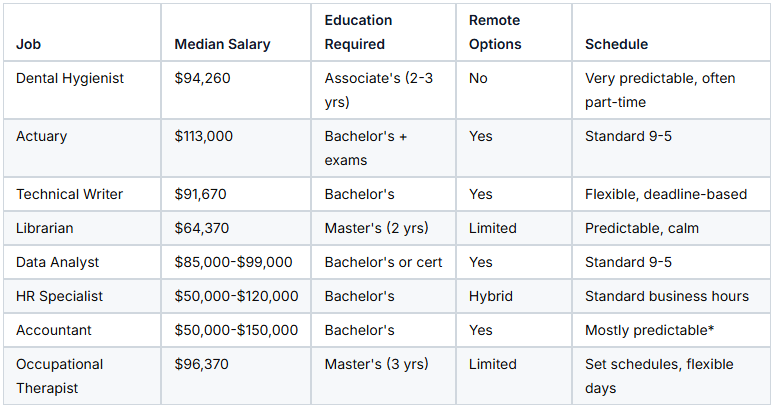
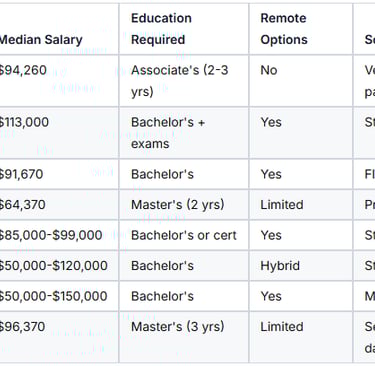
*Tax season (Jan-Apr) is busy; rest of year is flexible.
What's Your Next Move?
If you're stuck in a career that steals your evenings, know this: it doesn't have to be that way.
Changing careers feels scary. But so does waking up in ten years and realizing you missed the whole thing.
I would rather earn less income working a job during the day than earn more money at a job in the evening. That's not a sacrifice. That's a choice about what actually matters.
Your future self will thank you for choosing time.
Garrett Duyck is the founder of CheatCode Wealth and the writer behind the Portfolios & Bedtime Stories newsletter. He writes for employed people who want to build wealth without quitting their job, burning out, or missing out on life. Garrett is a former contributor to Seeking Alpha, where he built an audience of more than 4,000 readers, and he has published more than 140 articles about investing, passive income, and personal finance. He was among the top 20% of analysts according to TipRanks.
He has built a portfolio of income-producing assets that generates more than $50,000 per year in passive income, and he and his wife have paid off more than $180,000 in non-mortgage loans while raising four children. Garrett grew up in poverty, became a first-generation college graduate, and believes the best money strategies are the ones real families can actually stick with over time.
Educational Disclosure: CheatCode Wealth content is for educational and informational purposes only. It is based on personal experience, research, and firsthand investing practice. It is not personalized financial, legal, tax, or investment advice. Always perform your own due diligence and consult with a licensed professional before making significant financial decisions.
Affiliate Disclosure: To support the site, some links in our articles may be affiliate links. If you click on these and make a purchase, CheatCode Wealth may receive a small commission at no additional cost to you. We only recommend tools and services that Garrett has personally used or thoroughly vetted for the CheatCode community.
New to CheatCode Wealth? Start with our Paycheck-to-Passive guide to see how we build the foundation.
Connect & Explore:
Learn more about Garrett · Explore wealth-building tools · Garrett’s Seeking Alpha Archive · Connect on LinkedIn


About the Author


Subscribe to the newsletter and get a free copy of 101 Money Cheat Codes:
Spam-free. Unsubscribe anytime.
CheatCode Wealth™
Build your wealth. Keep your life.
© 2025. All rights reserved. Cheatcode Wealth LLC. This webpage may contain paid affiliate links.