
Job Offer Comparison Tool: See the Full Picture Before You Decide
A higher salary doesn't always mean a better job. The real winner is whichever offer puts more money in your pocket, supports your life outside of work, and fuels your path to financial freedom faster.
The Job Offer Comparison Tool gives you a complete side-by-side view of two offers — salary, benefits, retirement contributions, commute costs, paid time off, and the qualitative factors that spreadsheets usually miss. Make your decision based on total compensation, not just the number at the top of the offer letter.
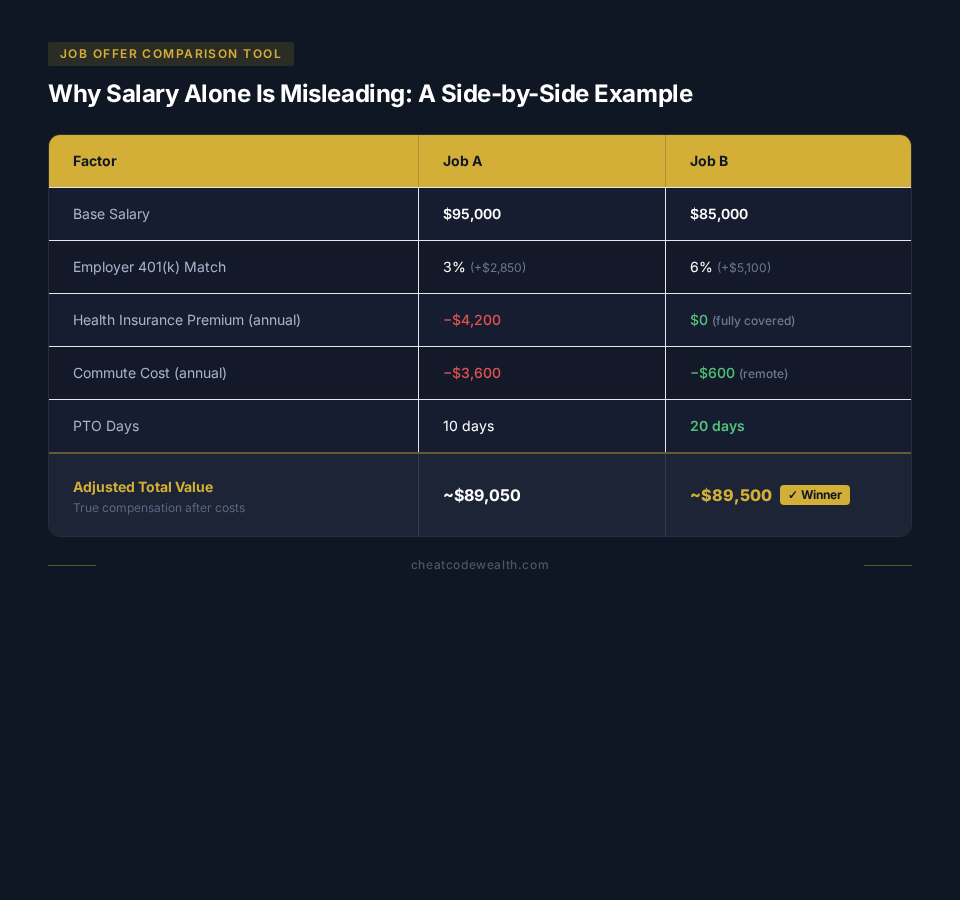
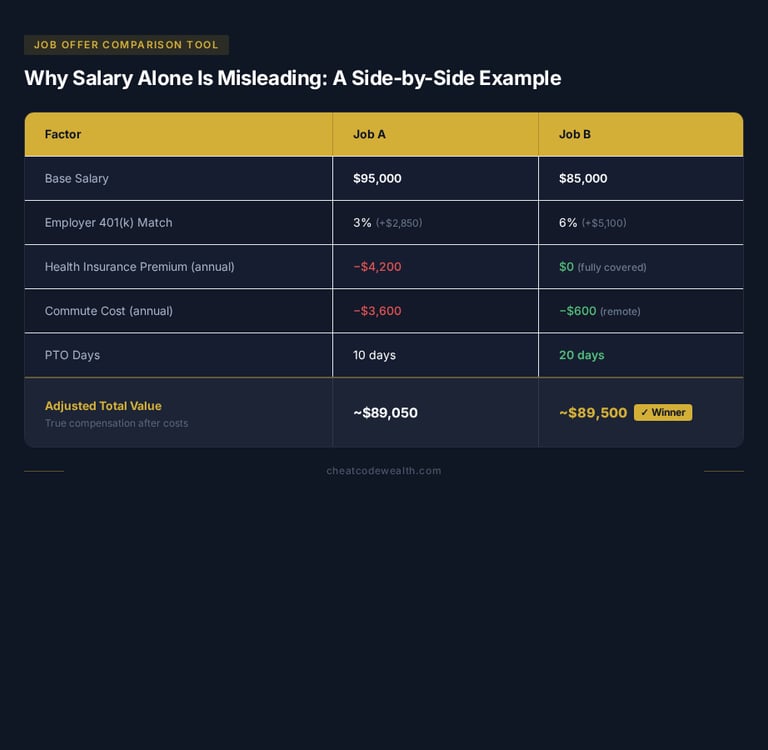
Why Salary Alone Is a Misleading Number
Most people compare job offers by looking at base salary first. That's understandable — it's the most visible number. But it's often the least accurate measure of which job is actually better.
The job that maximizes your net take-home value — after all costs and benefits are factored in — is the one that gives you the most to invest toward financial freedom.
What the Job Offer Comparison Tool Evaluates
This tool goes beyond base salary to give you a true apples-to-apples comparison. Here's what it accounts for:
Monetary Compensation
Base salary
Signing bonus
Annual bonus / performance pay
Equity or stock compensation
Benefits & Retirement
Employer 401(k) or retirement plan contribution/match
Health, dental, and vision insurance value
HSA/FSA employer contributions
Life and disability insurance
Real-World Costs
Commute costs (fuel, transit, parking, time)
Required out-of-pocket work expenses
Relocation costs (if applicable)
Time & Lifestyle Factors
Paid time off (PTO, vacation, sick days)
Expected working hours per week
Remote or hybrid flexibility
Schedule flexibility
Qualitative Factors
Career growth potential
Job stability and company health
Work environment and culture fit
Work-life balance
Alignment with your personal goals
No single number can capture all of this. The tool organizes it so you can.
How to Use the Job Offer Comparison Tool
Step 1 — Enter Job A details.
Start with your current job or the first offer. Fill in the compensation, benefits, and costs as accurately as you can. Estimates are fine — directional clarity is the goal.
Step 2 — Enter Job B details.
Enter the second offer using the same framework. The parallel structure makes it easy to see what's included and what you haven't accounted for yet.
Step 3 — Review the side-by-side results.
The tool surfaces the differences across every category — monetary and non-monetary — so you can see where each job wins, loses, and ties.
Step 4 — Factor in qualitative scores.
Rate each job on the qualitative factors that matter most to you: career growth, culture fit, flexibility, work-life balance. These don't always show up in the math but they belong in the decision.
Step 5 — Make your decision based on total value.
Use the results to make a clear, informed choice — not a gut-feel guess based on salary.
Pro tip: Don't forget to factor in what a better-compensating job could do for your passive income timeline. Every extra dollar of net compensation you direct into income-producing assets accelerates your path to your Freedom Number. Find your Freedom Number →
How This Fits the Bigger Picture
The Job Offer Comparison Tool isn't just about choosing a job. It's about maximizing the fuel you have to build wealth.
At CheatCode Wealth, active income is the foundation of the Paycheck-to-Passive™ method. The more your job pays you — in real net terms, not just headline salary — the more you can redirect into income-producing assets. More assets mean more passive cash flow. More passive cash flow closes the gap to your Freedom Number.
A job decision is also a wealth-building decision.
That $5,000 difference in total compensation between two offers isn't just $5,000. If invested at a 7% annual return for 20 years, it becomes over $19,000. Compounded across a decade of better job decisions, the gap between choosing based on salary vs. total compensation can be tens or hundreds of thousands of dollars.
This is why the CheatCode Approach treats career optimization as part of the wealth-building system — not separate from it. Your job is one of your most powerful income-producing assets, and like any asset, you should evaluate it carefully before you commit.
Frequently Asked Questions
What is the Job Offer Comparison Tool?
The Job Offer Comparison Tool is a free tool from CheatCode Wealth that lets you compare two job offers side by side across salary, benefits, retirement contributions, commute costs, paid time off, and qualitative factors — so you can evaluate total compensation, not just headline pay.
Is this tool free?
Yes. The Job Offer Comparison Tool is completely free to use, with no account or sign-up required.
What does "total compensation" mean?
Total compensation is the complete value of a job offer — including base salary, bonuses, employer retirement contributions, health benefits, paid time off, and any other monetary or non-monetary perks. Two jobs with the same base salary can have very different total compensation values.
Can I compare my current job against a new offer?
Absolutely. Many users enter their current job as Job A and a new offer as Job B to evaluate whether the switch is actually worth it financially.
What non-monetary factors does the tool include?
The tool accounts for factors like remote or hybrid flexibility, career growth potential, work-life balance, job stability, company culture, and expected working hours — factors that affect your quality of life even if they don't show up on a pay stub.
Why should I include commute costs in my comparison?
Commute costs — fuel, parking, tolls, or transit — come directly out of your take-home pay and your time. A job that pays $5,000 more per year but costs $4,000 more in commuting expenses is effectively a $1,000 raise, not a $5,000 one. Remote and hybrid roles often have a significant hidden financial advantage.
How does retirement matching affect total compensation?
Employer retirement matching is essentially free money added to your compensation. A 6% match on an $80,000 salary is $4,800 per year — a benefit that's easy to overlook when comparing headline salaries. The tool makes this visible so you can include it in your comparison.
What if I don't know all the details of one offer?
Use your best estimates for any unknown fields. The tool is designed for directional clarity, not accounting precision. Even approximate numbers will reveal meaningful differences between offers.
How does choosing the better job help me build passive income faster?
Your job is the engine that funds your investing. The more net compensation your job generates — after all costs — the more you can direct into income-producing assets each month. Maximizing your job's real value is the first step in the Paycheck-to-Passive™ method. Find your Freedom Number →
Should I use this tool before or after negotiating?
Both. Use it before negotiating to identify which benefits or perks you're leaving money on the table for — retirement match, health insurance, and remote flexibility are often more negotiable than base salary. Use it after negotiating to confirm the final offer beats your alternatives.
Related Guides
Explore related guides and tools to go deeper on this topic.

Make every career move count.
Join the Portfolios & Bedtime Stories newsletter for compensation, negotiation, and wealth-building insights.
CheatCode Wealth™
Build your wealth. Keep your life.
© 2025. All rights reserved. Cheatcode Wealth LLC. This webpage may contain paid affiliate links.