
Find Your Newsletter Niche: Discover What You're Uniquely Qualified to Write About
Everyone has something worth writing about. The problem isn't a lack of knowledge — it's not knowing which slice of your experience, expertise, or perspective is actually valuable enough to build a newsletter around.
The Newsletter Niche Finder helps you solve that. Answer a few questions about your background, interests, and experience, and the tool surfaces niche ideas uniquely matched to you — ideas you can actually sustain writing about week after week, and that have real potential to generate income alongside your job.
Why a Newsletter Is One of the Best Side Incomes for Employees
Most side income ideas require either significant startup capital, technical skills, or massive blocks of time. A newsletter requires none of those. What it requires is something every working professional already has: knowledge other people will pay to receive.
Here's why newsletters stand out as a side income vehicle for busy employees:
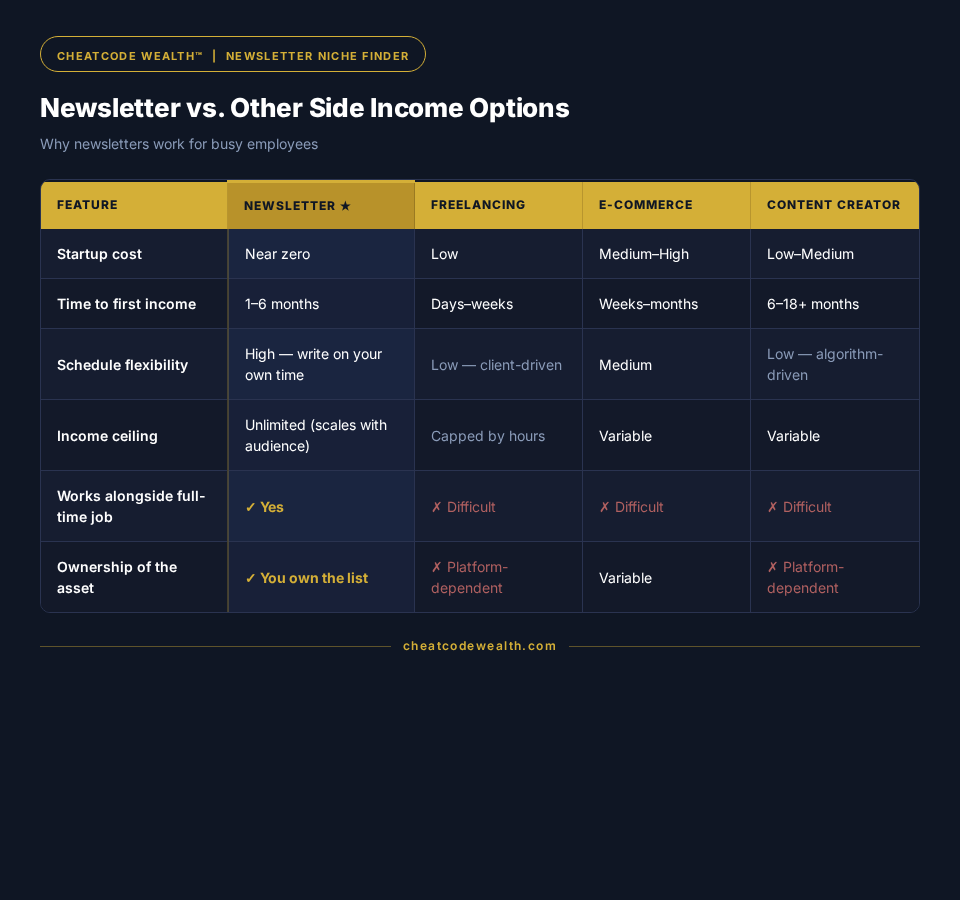
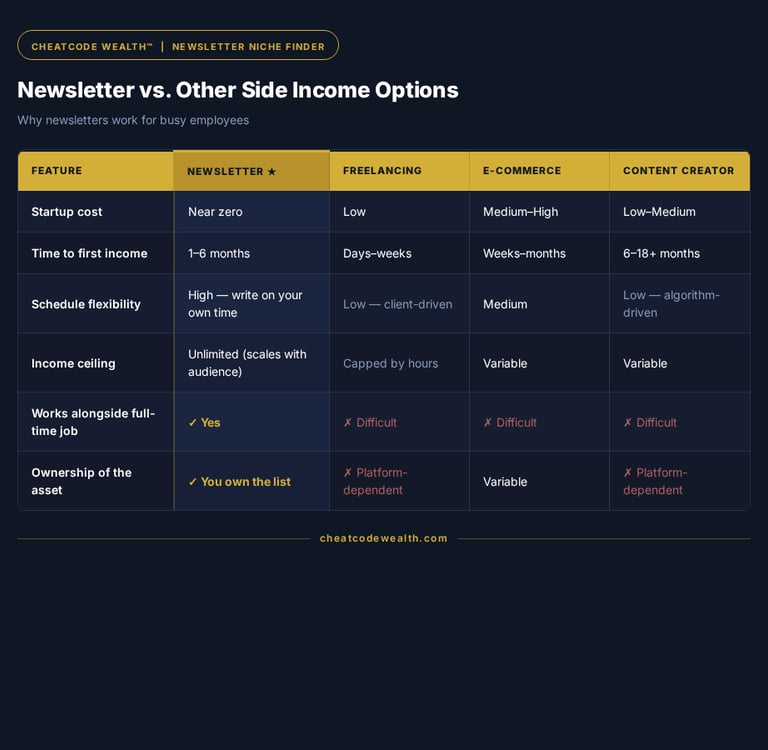
The key advantage: You write once, and your content reaches every subscriber at the same moment. Your time investment is fixed — your audience can grow indefinitely. That asymmetry is what makes newsletters one of the most efficient income vehicles for employees who can't trade unlimited hours for money.
Garrett Duyck built the Portfolios & Bedtime Stories™ newsletter alongside a full-time federal job and a family of four — not by working more hours, but by writing about what he already knew. That's the model this tool is built to help you replicate.
What the Job Offer Comparison Tool EvaluatesHow Newsletter Income Actually Works
Before you find your niche, it helps to understand how newsletters make money — because the income model shapes what kind of niche works best.
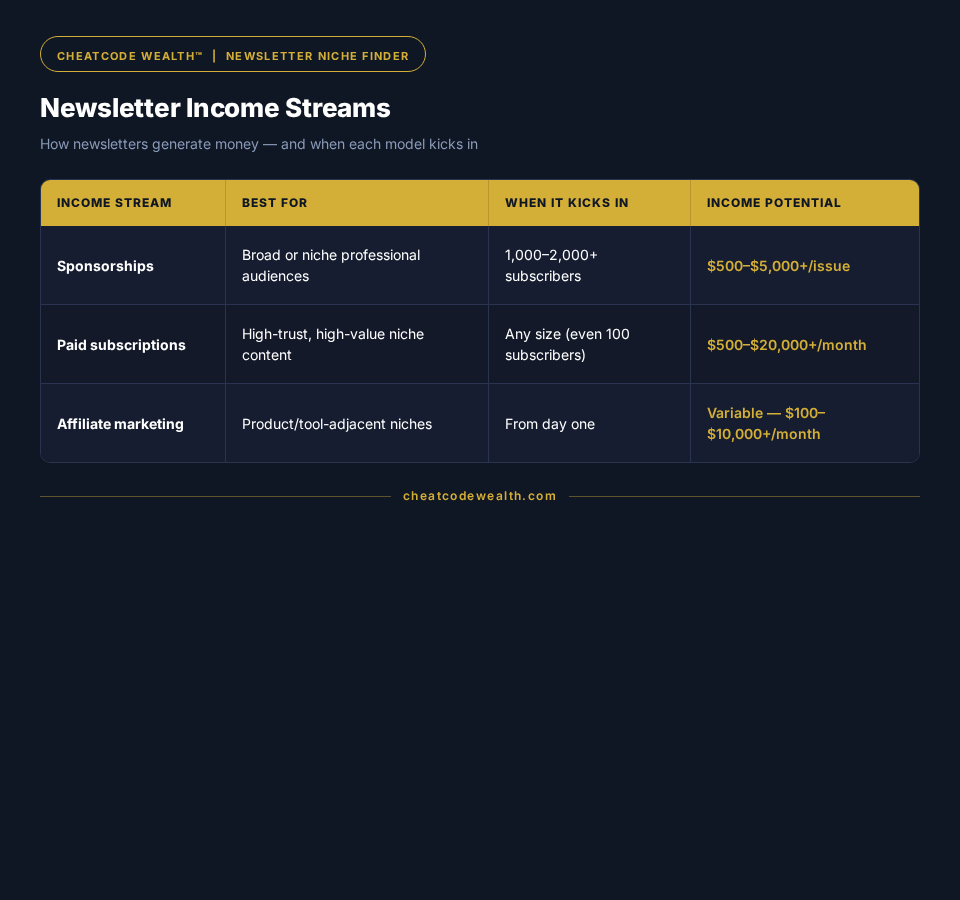
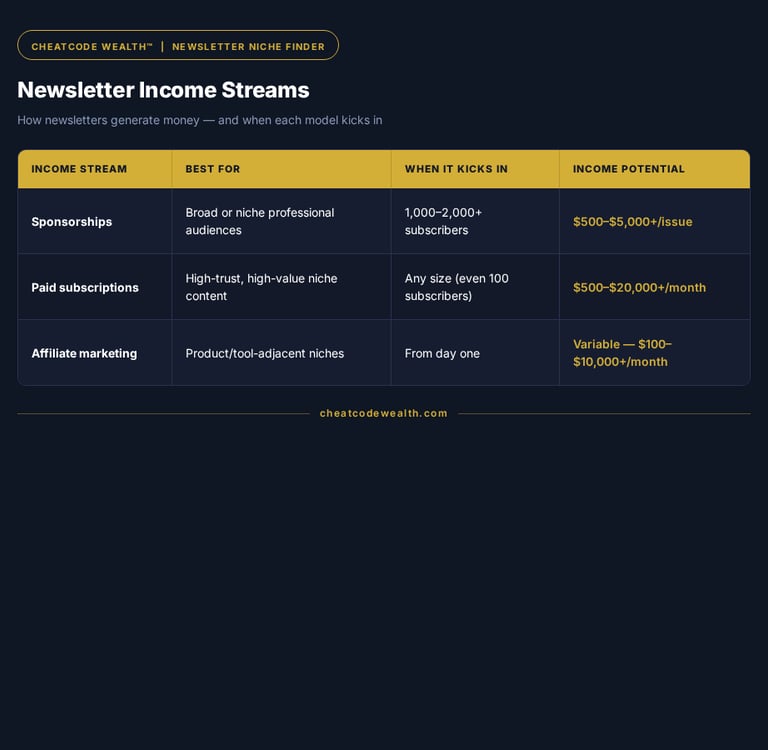
The three primary newsletter income streams:
1. Sponsorships & Advertising
Brands pay to place an ad or sponsored message inside your newsletter. Rates typically range from $20–$50 per 1,000 subscribers (CPM) for general audiences, and significantly higher for niche, high-income, or professional audiences. A newsletter with 5,000 engaged subscribers in a valuable niche can realistically earn $500–$2,500 per issue from a single sponsor.
2. Paid Subscriptions
Readers pay a monthly or annual fee for premium content. Platforms like Substack, beehiiv, and ConvertKit handle payments directly. Even a small paid subscriber base generates meaningful recurring income — 200 subscribers at $10/month = $2,000/month.
3. Affiliate Marketing
You recommend products, tools, or services you genuinely use and earn a commission when readers purchase through your link. This works best in niches where your readers are actively spending money on relevant products (investing platforms, software, education, etc.).
Most newsletters combine all three — free content builds the audience, sponsorships monetize the volume, and a paid tier or affiliate offers monetize the most engaged segment.
What Makes a Newsletter Niche Viable?
Not every topic makes a great newsletter. The best niches sit at the intersection of three things:
1. You have genuine knowledge or experience in it.
Your newsletter's competitive advantage is you — your perspective, your experience, your voice. Topics you've lived, worked, or studied give you something no AI-generated content or generic advice site can replicate: authenticity and specificity. This is what keeps readers subscribed month after month.
2. Other people actively want to learn about it.
Your niche needs an audience. That doesn't mean millions of people — a newsletter serving 2,000 passionate, specific readers consistently outperforms one with 50,000 disengaged ones. The question is: are there people who would pay (with attention or money) to learn what you know?
3. It has monetization potential.
Some topics attract audiences who spend money on related products, services, or education. Others are great for building an audience but harder to monetize. The strongest niches combine an engaged reader base with natural product or service adjacency.
The Newsletter Niche Finder evaluates all three dimensions — your experience, your audience potential, and your monetization fit — to surface ideas that are realistic for you specifically, not just generically popular.
The "You Already Know Something" Framework
The most common reason people don't start a newsletter is believing they're not expert enough. This is almost always wrong.
You don't need a PhD, a blue checkmark, or 20 years of experience. You need to know more than your reader does about something they care about — and be willing to share it consistently.
Think about it this way. You may be more qualified than you realize if you:
Work in a specialized field that others want to break into (government, healthcare, engineering, finance, education, law, trades)
Have navigated a major life transition (bought a home, changed careers, raised kids, paid off debt, moved cities, started investing)
Have a hobby or interest you've pursued deeply for years (woodworking, photography, running, cooking, a specific sport)
Have an unusual combination of skills or experiences that most people don't have together
Have solved a problem that many people struggle with (meal prepping, productivity systems, dealing with a specific health condition, managing a demanding job)
The niche isn't just the topic — it's your angle on the topic.
A newsletter about "personal finance" is too broad. A newsletter about "personal finance for federal employees navigating TSP, pension, and FEHB" is a niche. A newsletter about "investing for shift workers who can't follow the market in real time" is a niche. A newsletter about "building a side income as a teacher without burning out" is a niche.
Specificity is what makes you findable, memorable, and irreplaceable.
Newsletter Niche Categories — Where Employees Are Winning
The following niche categories consistently produce successful employee-run newsletters. They're organized by the type of knowledge that fuels them:
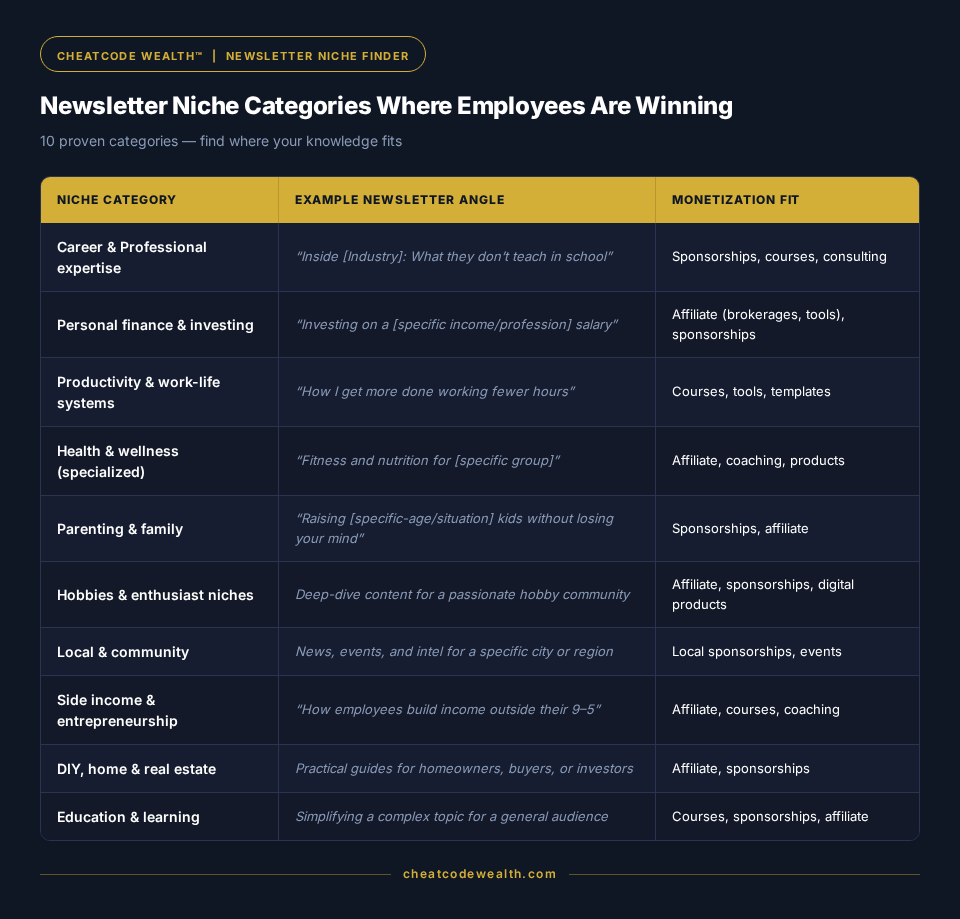
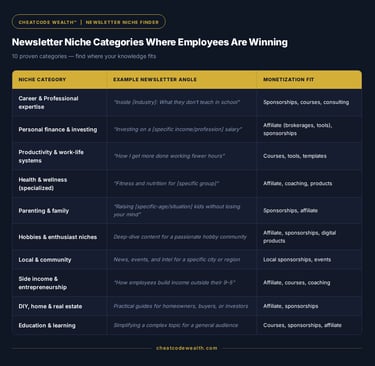
The best niche for you isn't necessarily the most popular one — it's the one you can write about consistently, that serves a real audience, and that gives you a unique edge.
How to Use the Newsletter Niche Finder
The tool works by asking you a series of questions about your background, experience, interests, and goals — then using your answers to identify newsletter niche ideas that are realistic, specific to you, and aligned with how newsletters actually generate income.
Step 1 — Answer the background questions.
Share your professional background, current job or field, and any specialized knowledge you've built over your career. Don't undersell yourself — depth matters more than prestige.
Step 2 — Identify your interests and passions.
What do you enjoy talking about, reading about, or doing in your off-hours? These often point to the most sustainable niches — topics you'll still want to write about after the initial motivation fades.
Step 3 — Describe the problem you've solved.
Think about the hardest thing you've figured out — at work, financially, personally, or in a hobby. Who else struggles with the same thing? That gap between where they are and where you are is your newsletter's value.
Step 4 — Set your goals.
Are you building a side income or eventually replacing your salary? Do you want a small, high-trust paid audience or a large free audience monetized through sponsorships? Your goals shape which niche strategy works best.
Step 5 — Review your niche suggestions.
The tool returns personalized niche ideas with a brief description of the audience, the income angle, and why it fits your specific profile. Use these as starting points — not final answers.
Pro tip: The best niche isn't always the first one that sounds exciting. Look for the idea that feels almost obvious in hindsight — the one where you think, "I already know all of this, I just never thought to write about it."
What Happens After You Find Your Niche?
Finding your niche is step one. Here's what comes next:
Validate before you commit. Tell 5–10 people in your life about your niche idea and watch their reaction. Do they immediately understand who it's for? Do they say "I know someone who'd love that"? That's a good sign.
Start small and consistent. Launch with one issue per week or biweekly. Consistency matters more than volume — a newsletter that shows up reliably builds trust; one that shows up randomly doesn't.
Build your list first. A small, engaged email list is worth more than a massive social media following you don't own. Focus on converting visitors to subscribers before worrying about monetization.
Monetize when the audience trusts you. Sponsorship and affiliate income follow audience trust. Trying to monetize too early — before readers know what your newsletter stands for — often kills the relationship before it starts.
Treat it like an asset, not a hobby. The newsletters that generate real income are run by people who treat them like a business from day one: tracking open rates, testing subject lines, and reinvesting early earnings into growth.
Frequently Asked Questions
What is the Newsletter Niche Finder?
The Newsletter Niche Finder is a free tool from CheatCode Wealth that asks you questions about your background, expertise, and interests — then returns personalized newsletter niche ideas aligned with your specific knowledge and income goals.
Is this tool free?
Yes. Completely free to use with no account or sign-up required.
Do I need to be an expert to start a newsletter?
No. You need to know more about your topic than your readers do — not everything there is to know. Many of the most successful newsletters are written by practitioners sharing their real-world experience, not academics or credentialed experts. Your lived experience and specific angle are the differentiator.
How much money can a newsletter make?
Income varies widely based on audience size, niche, and monetization model. A newsletter with 1,000 engaged subscribers in a valuable niche can realistically earn $500–$2,000/month from sponsorships alone. Paid subscription newsletters can generate meaningful income with even smaller audiences — 200 subscribers at $10/month is $2,000/month in recurring revenue. Top newsletter creators earn six and seven figures annually.
How long does it take to make money from a newsletter?
Most newsletter creators begin earning meaningful sponsorship income around 1,000–2,000 subscribers. Paid subscriptions can begin generating income from day one with a small audience. Building to 1,000 subscribers typically takes 3–12 months depending on your consistency and promotion strategy. Treat the first 6 months as investment, not paycheck.
Can I run a newsletter while working a full-time job?
Yes — this is exactly who this tool is built for. A weekly or biweekly newsletter typically requires 2–5 hours of writing and editing per issue. Most employees write during evenings, weekends, or early mornings. The schedule is fully yours to set.
What platform should I use to start a newsletter?
The most popular options are beehiiv, Substack, and Kit (formerly ConvertKit). Each has different strengths: beehiiv has the strongest built-in monetization and growth tools; Substack has built-in discoverability; Kit is excellent if you plan to sell your own products alongside the newsletter. All three have free tiers to start.
What if I pick the wrong niche?
Picking an imperfect niche and iterating is far better than waiting for the perfect one. Most successful newsletter creators pivoted or refined their niche within the first year based on reader feedback and engagement data. The Newsletter Niche Finder gives you a strong starting point — the market tells you the rest.
What is the difference between a newsletter niche and a newsletter topic?
A topic is broad (personal finance, health, productivity). A niche is specific — it identifies a particular audience, angle, and perspective that makes your newsletter distinct from everything else on that topic. "Personal finance for first-generation college graduates" is a niche. "How to invest on a teacher's salary" is a niche. Specificity is what makes a newsletter findable and memorable.
How does a newsletter fit into the Paycheck-to-Passive™ method?
A newsletter is a content asset — one of the 7 Classes of Income-Producing Assets recognized in the CheatCode Wealth system. Like a dividend stock or rental property, a newsletter generates recurring income from an asset you've built. The key difference: the asset is your audience and your archive of published content. As both grow, so does your income potential — without proportionally more of your time.
Related Guides
Explore related guides and tools to go deeper on this topic.

Make every career move count.
Join the Portfolios & Bedtime Stories newsletter for compensation, negotiation, and wealth-building insights.
CheatCode Wealth™
Build your wealth. Keep your life.
© 2025. All rights reserved. Cheatcode Wealth LLC. This webpage may contain paid affiliate links.