
How AI Is Changing the Way People Earn Money in 2026
Full-time employee shares how AI transformed his earning potential. Real results, honest trade-offs, and a practical framework for employees navigating AI.
ARTIFICIAL INTELLIGENCEMONEYINVESTINGACTIVE INCOME
Garrett Duyck
4/6/202616 min read
Quick Navigation: Explore the blog | Active Income | Passive income | job SHaming | Stairstep retirement


If you've been watching the news lately, you've probably noticed a pattern. Every other headline is about AI taking jobs, AI replacing workers, and AI making entire careers obsolete overnight. It's exhausting. And if you're a full-time employee just trying to do your job, raise your family, and maybe get ahead financially, this stuff can feel genuinely threatening.
I get it. I'm a full-time employee and a father of four. My wife and I discuss what the future will be like for our children. We wonder: what will their future look like for jobs? How will college be different for them? How do we help them pick the right field of study? It can be tempting to throw your hands up and tell the kids, "Just go into the trades! AI can't install pipe." But that's not helpful.
I don't have time to panic about the future of work. But I also can't afford to ignore it. So I did something about it. I started using AI every single day, both at my job and in building this website, CheatCode Wealth. And what I learned surprised me.
I didn't lose my job. I got better at it. I built an entire business with no coding experience. I saved hundreds of hours on research, career planning, and content creation. I wrote ebooks, built a website, and created tools that would have taken me years to develop on my own.
Here's what I want you to walk away with after reading this: AI isn't coming for your paycheck. It's coming for the friction that slows you down. And if you understand what that means, you can position yourself to earn more, not less, in the years ahead.
Full disclosure: I'm going to recommend a specific AI tool in this article, Abacus.AI and its DeepAgent feature. It's the tool I personally use and spend $40+ per month on. I'll include a referral link, which means I may earn a commission at no extra cost to you if you sign up through it. But I only recommend tools I actually use, and this one has been a genuine game-maker for me. It's been a life-cheat code.
Now, let me show you exactly how AI is reshaping the way people earn money, what it means for your career, and how you can come out ahead.
Why This Matters for Employees in 2026
To understand AI's impact on earnings, you need to zoom out for a second and see the bigger picture.
Every major leap in information technology has transformed how people work and earn.
The printing press made knowledge portable.
The internet made sharing information exponentially easier.
Search engines made finding information exponentially easier.
And now, AI is making information synthesis exponentially easier.
That's the keyword: synthesis. Not just finding facts, but understanding what they mean, connecting them, and applying them to your specific situation.
Think about it this way. Before search engines, if you wanted to know something, you had to go to a library, find the right book, flip to the right chapter, and read until you found your answer. That's what I call "search friction": the time and effort wasted simply locating information.
Search engines eliminated most of that friction. But they introduced a new problem. You could find a thousand articles on any topic, but you still had to read, compare, filter, and make sense of them. That's "synthesis friction": the time wasted making sense of information once you've found it.
AI eliminates both. It doesn't just find relevant information. It understands your context, identifies what matters to you specifically, and presents synthesized answers. That's not a small improvement. That's an order-of-magnitude leap, just like search engines were an order-of-magnitude leap over card catalogs.
Why does this matter for employees in 2026? Because your job is a wealth-building tool, not a prison. That's a core belief at CheatCode Wealth. And when the primary tool you use at work, information, suddenly becomes radically easier to access, synthesize, and apply, the value of your time at work changes. Some people will see their earning power increase dramatically. Others will find their roles shrinking. The difference comes down to whether you learn to use AI as a tool or ignore it and hope for the best.
We're living through a shift as significant as the transition from typewriters to computers. The people who adapted to computers didn't lose their careers. They accelerated them. The same is true with AI, but only if you understand what's actually changing and position yourself accordingly. People are fearful of AI today because they expect it to eliminate the waste from their jobs, and without that waste, they will no longer be needed at work. This is precisely the point!
With less waste, production will increase. Workers will be retooled. And the ones that adapt will flourish.
My Personal Experience: Building a Business with AI and No Coding Background
This is where it gets real. I'm not a tech guy. I'm a conservation planner for a federal agency. My day job involves soil health, land management, and helping farmers and ranchers protect natural resources. I have no background in coding, web development, or digital marketing.
But in early 2025, I started using AI daily, and it changed everything.
How It Started
It began with curiosity. I had been thinking about building CheatCode Wealth for a while. I wanted to create a resource for young adults, people like me who grew up with nothing and had to figure out the financial system on their own. But the idea of building a website, writing articles, creating ebooks, and developing a brand felt overwhelming. I figured it would take years of learning web development, hiring freelancers, or saving up to pay a developer.
Then I started experimenting with AI tools. Within weeks, I realized I could do things I never thought possible.
What I Built
I built this entire website and business using AI, with no prior coding experience. Let me break down the timeline:
Early 2025: Started using AI for research and writing. I was blown away by how quickly I could synthesize complex financial topics into clear, readable content. What used to take me 8-10 hours of research and writing could be done in 2-3 hours with AI assistance.
Mid 2025: Discovered Abacus.AI and its DeepAgent. This was a turning point. DeepAgent doesn't just answer questions; it acts like a personal employee. It can research topics, build applications, write code, create documents, and execute multi-step tasks autonomously. I used it to build website features, create planning tools, and develop content strategies.
Late 2025 to Present: Built out the full CheatCode Wealth platform, including ebooks, a newsletter framework, financial planning resources, and this blog. I also used AI to create visual assets, develop my content calendar, and plan my SEO strategy.
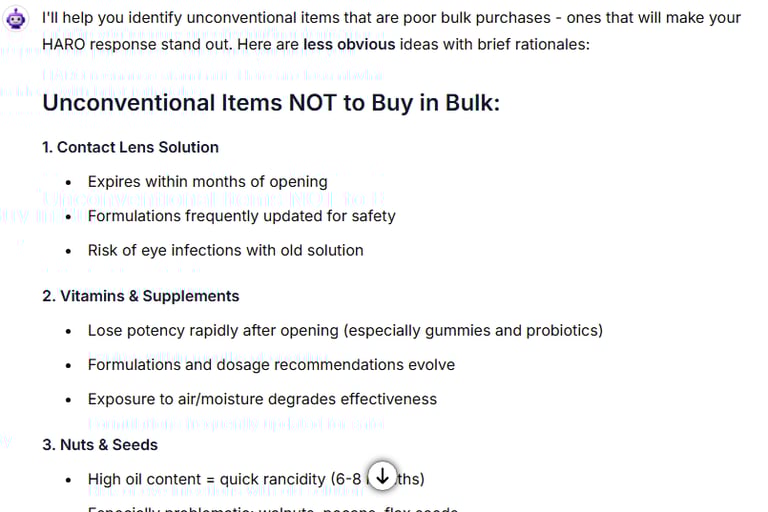
Here's a screenshot example of what DeepAgent taught me when I asked for 10 ideas of items that should not be purchased in bulk to save money:
The Numbers
Here's what this looked like in practice:
Time saved: Hundreds of hours on research, writing, planning, and development.
Cost: I spend $40+ per month on Abacus.AI, beyond the premium plan which is $20/month, because the value justifies it many times over.
Output: Multiple ebooks, a full website, dozens of articles, planning tools, and a growing newsletter.
Prior experience required: Zero coding, zero web development, zero design.
What Surprised Me
The biggest surprise wasn't the efficiency gains. It was how AI changed my thinking. When search friction and synthesis friction disappear, you stop spending mental energy on finding and organizing information and start spending it on creative problem-solving. I found myself asking better questions, seeing connections I'd missed before, and developing frameworks that I never would have reached if I were still buried in Google tabs. I was able to explore my ideas and creations more because I was spending less time on routine tasks.
A Real Example from My Day Job
Here's a concrete example of how AI eliminates search friction at work. In my role at USDA, I frequently need to reference specific policy documents, technical standards, and conservation practice guidelines. Before AI, finding the right policy reference meant digging through multiple databases, cross-referencing document numbers, and reading dense regulatory text. It could take 30-60 minutes to locate and verify a single reference.
Now, I can describe what I need in plain language, and AI identifies the relevant policy, pulls the exact section, and explains how it applies to my specific situation. Normal word searching does not always work in these cases, but AI does. What took an hour takes five minutes. That's search friction, eliminated.
That time savings compounds. Over a week, a month, or a year, I'm getting back hundreds of hours I can redirect toward higher-value work.
The Framework: How AI Changes Earning
Now let's get into the substance. AI changes how people earn money in two fundamental ways: it revolutionizes work and investing. Understanding both is critical.
Part 1: AI Revolutionizes Work
The core mechanism is simple: AI eliminates search friction and synthesis friction from information-based work.
Any job that involves finding, organizing, interpreting, or applying information becomes dramatically more efficient with AI. This includes roles in finance, law, healthcare, engineering, marketing, education, government, and dozens of other fields.
But "more efficient" doesn't mean "more valuable" for everyone equally. Here's the critical nuance:
Some careers gain earning power. If your job involves complex decision-making, creative problem-solving, or applying expertise to unique situations, AI makes you faster and more effective. You can handle more work, deliver better results, and become more valuable to your employer. The World Economic Forum projects a net increase of 170 million jobs by 2030, largely in roles that leverage AI.
Some careers lose earning power. If your job is primarily about performing tasks that AI can now do independently, like basic data entry, simple content generation, routine customer service, or standard document processing, the demand for your specific skills decreases. Goldman Sachs estimates AI could replace the equivalent of 300 million full-time jobs' worth of tasks globally.
Jensen Huang, the CEO of NVIDIA, put it perfectly: "You won't lose your job to AI, but to someone who uses AI."
He also gave a powerful example about radiology. When AI started reading medical images, many predicted that radiologists would become obsolete. Instead, the number of radiologists increased. Why? Because AI made each radiologist more productive, increasing overall capacity. It also made radiology services more affordable, increasing demand. The radiologists who embraced AI became more valuable, not less.
This pattern, where technology increases rather than eliminates demand for skilled workers, has repeated throughout history. The key is that you have to be one of the people who embrace the tool.
Part 2: AI Revolutionizes Investing
Here's where most people miss the bigger picture. AI doesn't just change how you work. It changes the value of the assets you invest in.
At CheatCode Wealth, I teach a framework called the 7 Classes of Income Producing Assets. AI impacts each class differently, and understanding these differences is essential for making smart investment decisions.
Digital assets are seeing the most disruption. Ebooks, SaaS products, affiliate marketing websites, and other digital income streams are experiencing increased competition and, in many cases, lower margins. Why? Because AI lowers the barrier to creating these assets. When anyone can write a book, build a website, or create a digital product with AI, the supply of digital assets explodes.
Here's a real example: Amazon KDP (Kindle Direct Publishing) has been flooded with AI-generated books. The platform has had to implement submission limits of three books per day per author and require mandatory AI disclosure because the volume of low-quality, AI-generated content was overwhelming the marketplace. Human authors now face intense competition from mass-produced AI content. In some categories, a significant percentage of bestselling ebooks have been identified as likely AI-generated.
Another example: AI is bypassing traditional search engines. Google's AI Overviews now appear in about 16% of U.S. searches and have reduced website clicks by an average of 34.5%. For affiliate marketers who depend on search traffic, this is a fundamental shift. If AI answers the user's question directly in the search results, the user never clicks through to your affiliate site. I've noticed this myself as I build CheatCode Wealth's content strategy. The old playbook of "write SEO content, rank on Google, earn affiliate commissions" is being disrupted.
Physical and real estate assets are less impacted. AI can't build a house, fix a plumbing leak, or manage a rental property in the physical world. Real estate, equipment, and other tangible assets retain their value because they exist in the physical world where AI's reach is limited. If anything, AI tools can make managing these assets more efficient.
Part 3: The Opportunity
Here's the exciting part. Despite the disruption, AI creates enormous opportunities for employees who are paying attention.
Jensen Huang said something that stuck with me: "Everybody in the world is now a programmer." He meant that through AI, anyone can build software, create tools, and automate processes, regardless of their technical background. You don't need a computer science degree. You need a clear idea of what you want to build and an AI tool to help you build it.
That's exactly what I did. I'm a conservation planner, not a developer. But with AI, I built a website, created digital products, and launched a business. The technical barriers that would have stopped me five years ago no longer exist.
Think about what this means for you as an employee:
You can build a website for your side project without learning to code
You can write and publish an ebook in a fraction of the time it used to take
You can analyze complex data for your job without being a data scientist
You can create professional content without being a professional writer
You can automate repetitive tasks at work and become dramatically more productive
Tools like Abacus.AI DeepAgent essentially function as a personal employee that costs pennies to employ. For less than $2 a day, I have access to an agent that can research, write, code, analyze, and build. That's a capability that used to require hiring a freelancer at $50-100+ per hour.
The democratization of information technology through AI means the playing field between large companies with big budgets and individual employees with big ideas is more level than ever. The question isn't whether AI will change how you earn money. It already is. The question is whether you'll use it to your advantage.
Pros, Cons, Alternatives, and Lessons Learned
I want to be honest with you about all sides of this, because the reality is more nuanced than either the utopian "AI will solve everything" or the dystopian "AI will destroy all jobs" narratives.
Pros
Accessibility: You don't need a technical background to leverage AI. I'm proof of that. If a conservation planner can build a business with AI, you can too.
Time savings: The efficiency gains are real and massive. Tasks that took hours now take minutes. This adds up to hundreds of hours saved per year.
Democratization: AI levels the playing field. Small businesses and individual employees can now compete with larger organizations in ways that were impossible before.
New career paths: AI has created entirely new roles, from prompt engineers ($160,000+) to AI ethics specialists, that didn't exist five years ago.
Cons
Increased competition in digital spaces: When everyone can create content, the supply of content explodes, and individual pieces become less valuable. This is real, and I've seen it firsthand with the Amazon KDP situation.
Some jobs will genuinely shrink: Roles focused on routine information processing will face real displacement. Goldman Sachs' estimate of 300 million jobs' worth of tasks being automated isn't fearmongering; it's an honest projection.
Learning curve: AI tools are powerful but not always intuitive. There's a real investment of time and mental energy required to learn how to use them effectively.
Quality concerns: AI can produce confident-sounding garbage. You need human judgment to verify, refine, and ensure quality. Using AI without critical thinking is a recipe for mediocrity.
The Honest Truth About Job Loss
The fear of being replaced by AI is real, and I won't dismiss it. But the historical pattern is encouraging. Raoul Pal, the macro investor, said AI will have an "economic impact larger than any financial event seen before." He also said that "in five years, we will know nothing" compared to what AI will make possible, emphasizing how rapidly knowledge itself is being transformed.
That sounds scary. But it also means the people who learn to work with AI will have access to capabilities that are almost unimaginable today. The risk isn't AI itself. The risk is standing still while the world moves forward.
Lessons from My Journey
Start before you feel ready. I didn't wait until I understood AI perfectly. I started using it, made mistakes, and learned as I went. The best time to start was yesterday. The second-best time is today.
AI amplifies your thinking, it doesn't replace it. The better your questions, the better AI's output. Creative problem-solving has become more valuable to me, not less.
Physical and real-world skills remain valuable. Not everything is being disrupted. Trades, healthcare, and real estate are largely protected from AI displacement. A balanced approach to income and assets matters more than ever.
Common Questions
Q: Will AI actually take my job?
A: Probably not in the way you're imagining. AI is far more likely to transform your job than eliminate it entirely. The historical pattern with every major technology, from the printing press to the internet, has been that jobs change shape rather than disappear. Radiologists weren't replaced by AI imaging; they became more productive with it. The people most at risk are those who refuse to adapt, not those whose jobs involve information work. As Jensen Huang said, "You won't lose your job to AI, but to someone who uses AI."
Q: I'm not tech-savvy. Can I really use AI effectively?
A: Yes. I built an entire website and business with zero coding experience. Modern AI tools, especially agent-based tools like DeepAgent, are designed to work with natural language. You describe what you want in plain English, and the AI figures out how to do it. If you can write an email, you can use AI. The learning curve is real but manageable, and the payoff is enormous.
Q: How much does it cost to start using AI tools?
A: Many AI tools have free tiers that are genuinely useful. For more advanced capabilities, expect to spend $20-$50 per month. I personally spend $40+ per month on Abacus.AI because the value far exceeds the cost. Compare that to hiring a freelancer at $50-100+ per hour, and the economics are obvious.
Q: How long until I see real results from using AI?
A: It depends on what you're trying to accomplish. For work efficiency gains, you can see improvements within days. I noticed immediate time savings on research tasks. For building something larger, like a business or a passive income stream, expect a timeline of months. I started in early 2025 and had significant results by late 2025. The key is consistency: use AI daily, get comfortable with it, and build on what you learn.
Q: Does AI make passive income easier or harder to build?
A: Both. AI makes it easier to create digital products, content, and online assets. But it also makes it easier for everyone else, which increases competition. The net result is that quality, authenticity, and unique perspective matter more than ever. Generic, low-effort content gets buried. Thoughtful, experience-based content that AI can't easily replicate becomes more valuable. My approach: use AI for efficiency, but bring your own thinking, experience, and personality to everything you create.
Q: What's the single best thing I can do right now to prepare for AI's impact on my career?
A: Start using AI today. Not tomorrow, not next month. Today. Pick one AI tool and use it for something real, whether that's researching a work project, drafting an email, analyzing data, or exploring a business idea. The people who will thrive are those who build AI fluency now, while it's still early enough to gain a real advantage. I recommend Abacus.AI because they have a fantastic agent for beginners, Deep Agent, and they provide access to over 20 different LLM models, including Grok, Gemini, ChatGPT, and Claude. For beginners who don't know which model to use, there's the RouteLLM model, which sends your request to the best model from the list!
Q: Is AI just hype that will fade?
A: No. This is a fundamental advance in information technology. AI is a general-purpose technology, like electricity or the internet, that improves virtually every field it touches. The World Economic Forum projects 170 million net new jobs by 2030 driven by AI. Major corporations are investing hundreds of billions in AI infrastructure. This isn't going away. The question is how you position yourself relative to it.
Final Thoughts
Here's what I want you to take away from all of this:
AI is not your enemy. It's a tool, and like every tool before it, it rewards the people who learn to use it. The invention of the calculator did not eliminate the need for mathematicians.
Your job is still your greatest wealth-building asset. AI makes your work more efficient, not less valuable. Use the time you save to build passive income streams or invest in your skills.
The barrier to entry for building something of your own has never been lower. You don't need a technical background, a big budget, or years of training. You need an idea and an AI tool.
I built CheatCode Wealth as a full-time employee and father of four, using AI to do what would have previously required a team. That's not a brag. It's proof that this technology is accessible to ordinary people with ordinary schedules and extraordinary ambitions.
If you want to start experiencing these benefits yourself, I'd encourage you to try Abacus.AI DeepAgent. It's the tool I use daily, and it functions like a personal employee that costs pennies to employ. It can research, write, code, build, and execute complex multi-step tasks. I've tried many AI tools, and this is the one I keep coming back to and paying for.
👉 Try Abacus.AI and DeepAgent — This is an affiliate link. I may earn a commission at no extra cost to you if you sign up through it, but I only recommend tools I use.
Build your wealth. Keep your life. And use AI to do both.
Stay Connected
Want more strategies for building wealth without sacrificing your life?
Join my free newsletter, Portfolios and Bedtime Stories, where I share practical money advice for people who refuse to trade their family time for a bigger paycheck.

Garrett Duyck is the founder of CheatCode Wealth and the writer behind the Portfolios & Bedtime Stories newsletter. He writes for employed people who want to build wealth without quitting their job, burning out, or missing out on life. Garrett is a former contributor to Seeking Alpha, where he built an audience of more than 4,000 readers, and he has published more than 140 articles about investing, passive income, and personal finance. He was among the top 20% of analysts according to TipRanks.
He has built a portfolio of income-producing assets that generates more than $50,000 per year in passive income, and he and his wife have paid off more than $180,000 in non-mortgage loans while raising four children. Garrett grew up in poverty, became a first-generation college graduate, and believes the best money strategies are the ones real families can actually stick with over time.
Educational Disclosure: CheatCode Wealth content is for educational and informational purposes only. It is based on personal experience, research, and firsthand investing practice. It is not personalized financial, legal, tax, or investment advice. Always perform your own due diligence and consult with a licensed professional before making significant financial decisions.
Affiliate Disclosure: To support the site, some links in our articles may be affiliate links. If you click on these and make a purchase, CheatCode Wealth may receive a small commission at no additional cost to you. We only recommend tools and services that Garrett has personally used or thoroughly vetted for the CheatCode community.
New to CheatCode Wealth? Start with our Paycheck-to-Passive guide to see how we build the foundation.
Connect & Explore:
Learn more about Garrett · Explore wealth-building tools · Garrett’s Seeking Alpha Archive · Connect on LinkedIn


About the Author


Subscribe to the newsletter and get a free copy of 101 Money Cheat Codes:
Spam-free. Unsubscribe anytime.
CheatCode Wealth™
Build your wealth. Keep your life.
© 2025. All rights reserved. Cheatcode Wealth LLC. This webpage may contain paid affiliate links.